About project
Žofinka becomes a place for people – families with children, young entrepreneurs, elderly residents and students. The design represents a new urban district with a clear identity, a legible structure and a pleasant environment for all generations. The concept emphasizes sustainability, barrier-free access and connections with natural elements such as the Ostravice River and the surrounding area.
The key idea of the urban design of Žofinka is a clear and natural orientation in space. The spatial organization is based on clear lines, defined by dominant features and visually understandable stimuli that facilitate movement and orientation in the area. The urban concept emphasizes a socially responsible approach, diversification of housing and effective use of the natural characteristics of the area, including the terrain and existing vegetation. Together, these aspects create an attractive and functional place to live.
-
Client
Pod Žofinkou Holding a.s.
-
Year
2025
-
Location
Ostrava
-
Size
410 951 m2
-
Authors
Ján Antal
Kristýna Stará
Juraj Biroš
Oksana Džabarjan
Silvia Snopková
Dora Halamová -
Co-authors
Marko & placemakers
Petr Ivasienko -
Visualisations
Dousek – Záborský
Show all

URBAN PLANNING
The new district in Žofinka does not function as an isolated enclave, but rather naturally follows the existing urban structure. Despite its rugged terrain and infrastructural barriers that define the boundaries of the area, the district transforms these apparent limits into values and advantages. Connectivity with existing parts of the city is a fundamental principle for the development of the area.
The basic strategic principle is to connect the area through a pair of main urban axes. These axes point to the center of Ostrava and Dolní Vítkovice on one side, and connect the railway station and shopping center with the Ostravice River embankment on the other. Terrain modeling contributes to better orientation in space and supports visual connections with the more distant surroundings. Key nodes are created at the intersection of the main axes, which become natural, social and transport centers of the new district.

The inspiration for the structure of the original landscape mosaic is reflected in the concept of the area. This mosaic, taken over by industrial areas, is now enlivened by the parallelism with the dominant road network and a new urban lace — a combination of blocks of different sizes embedded in the contemporary urban environment. This element connects the past with the present and becomes the basis for the creation of a new coherent structure.
The center of the district is a park area that will connect to the green ring and access roads to the riverbank, which will enhance the recreational, ecological, and aesthetic values of the urban environment.
Diagram


ARCHITECTURE
Flexibility is one of the key principles of urban and urban district planning today. Given the long-term nature of the project, which is designed for approximately 30 years of construction, the ability to adapt to changing social, economic and spatial needs is ensured. This approach allows the city to respond to current challenges and future changes and ensures that the resulting environment will remain functional and relevant for several decades.
The basis of the design is a modern and variable urban block, which creates a universal matrix of the city. This block combines a diverse typology of development, a balanced mix of ownership and rental relationships, plenty of integrated greenery and an active parterre with services covering the daily needs of residents. Modular and flexible construction allows for easy configurability and optimization of space.
The dimensions of streets and buildings are designed with a human scale in mind, thus supporting a pleasant and functional living environment. Elevated landmarks serve as landmarks in the space and at the same time contribute to a dynamic and diverse urban landscape. The architecture emphasizes affordability, quality and social sustainability, thus creating the basis for a long-term prosperous and balanced city.
Diagram


LAYOUT OF FUNCTIONS AND SERVICES
The project has the ambition not to be exclusively a monofunctional residential zone, but is enriched with various types of housing and other functions that create a lively, dynamic and flexible urban district. The focus on various types of housing — from student, senior, rental to owner-occupied and individual construction of family houses on the Ostravice River embankment — allows different groups of residents to find suitable housing according to their needs and preferences.
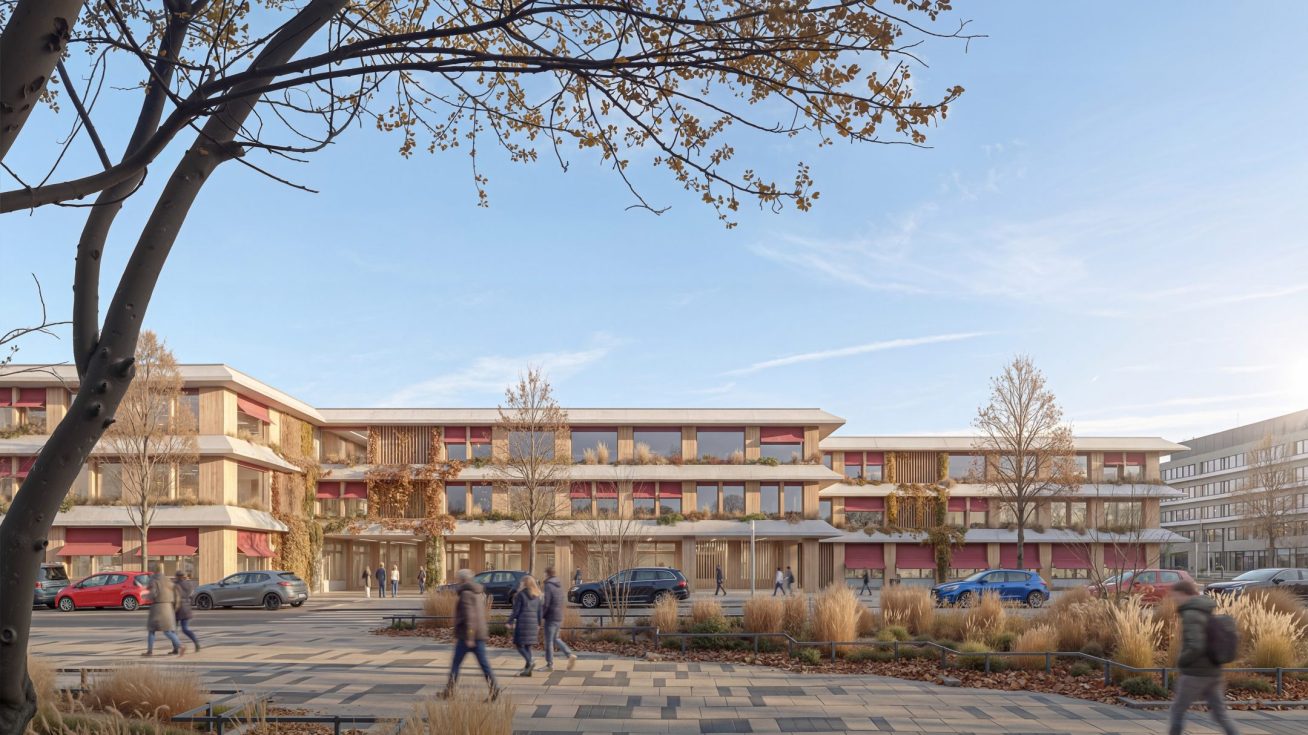
The proposal also includes a new school building with a gym, which will be located on the southern edge of the area, ensuring good connections to public transport and car traffic, as well as accessibility on foot from all parts of the area.


BLUE-GREEN INFRASTRUCTURE
The basic principle is to support the local water cycle, its purification and support of vegetation elements for fulfilling microclimatic functions, especially cooling the space. Due to the complex infiltration conditions, water in the HDV buildings is retained and regulatedly drained into the central green axis area – into dry polders using the natural morphology of the area. The polders will be designed for short-term retention of rainwater, i.e. without a permanent water level, and the water will then be drained into Ostravice. Infiltration of water purified through a soil filter can be ensured by vertical boreholes that would pass through impermeable layers of soil.
For buildings and surfaces of the transport infrastructure, emphasis is placed on preventing rainwater runoff through vegetated roofs and partially or fully permeable surfaces. Underground ditches with structural substrate and tree planting are used as the primary drainage system for street drainage. Rainwater not used by the trees is drained in a regulated manner through a system of connected buildings to the central park. Water flows along clearly defined paths, which protects property and important infrastructure.

PUBLIC SPACES
Lower and Upper Žofinka, two areas set in a green ring, interconnected by a central park that connects the area with the city center and the waterfront, and at the head of which stands an elementary school, an education and sports area, on the common border.
Public spaces are layered in the designed area hierarchically and spatially. A superior network of roads for individual and public transport, pedestrians and cyclists runs through the area, from which service roads are separated in both parts, offering lively street spaces with an active parterre, to which are connected nodal squares – the centers of individual parts, community centers. The main squares are connected to public transport stops. The solution minimizes traffic crossings and maximizes car-free zones.
The main square represents the central identification and social space of the district. The active zone of the square spatially and functionally “overflows” from the tram stop on the boulevard into the interior space, the dominant element of which is a monumental water feature. The square is designed as a car-free zone. Its open character allows for flexible year-round use for various activities.
The central park is conceived as a connecting element between two levels – the upper and lower parts of Žofinka – and represents the main active-relaxation space of the entire district. Its character is shaped by an undulating, modeled terrain with a natural and informal expression. The park also includes smaller children’s playgrounds.
The North Park forms an existing natural area between Žofinka and Nova Karolina. In this area, we are strengthening the natural character of the landscape. The space of the North Park is not purposefully programmed and is primarily intended for spontaneous relaxation activities.
The design of the school campus is based on the principle of connecting the educational environment with the landscape and the community. The key elements of the concept are the integration of greenery, the multifunctional use of outdoor areas and openness towards the community. The campus is set at the top of a green heart that naturally connects the school with the surroundings.


The Dlouhá Míle urban boulevard is a key part of the identity of the new district. Its clearly defined linear infrastructure ensures the necessary transport and service connection of the district with the center of Ostrava and Dolní Vítkovice and creates a strong urban character. The boulevard is complemented by cycling infrastructure and is lined with a distinctive avenue of trees.
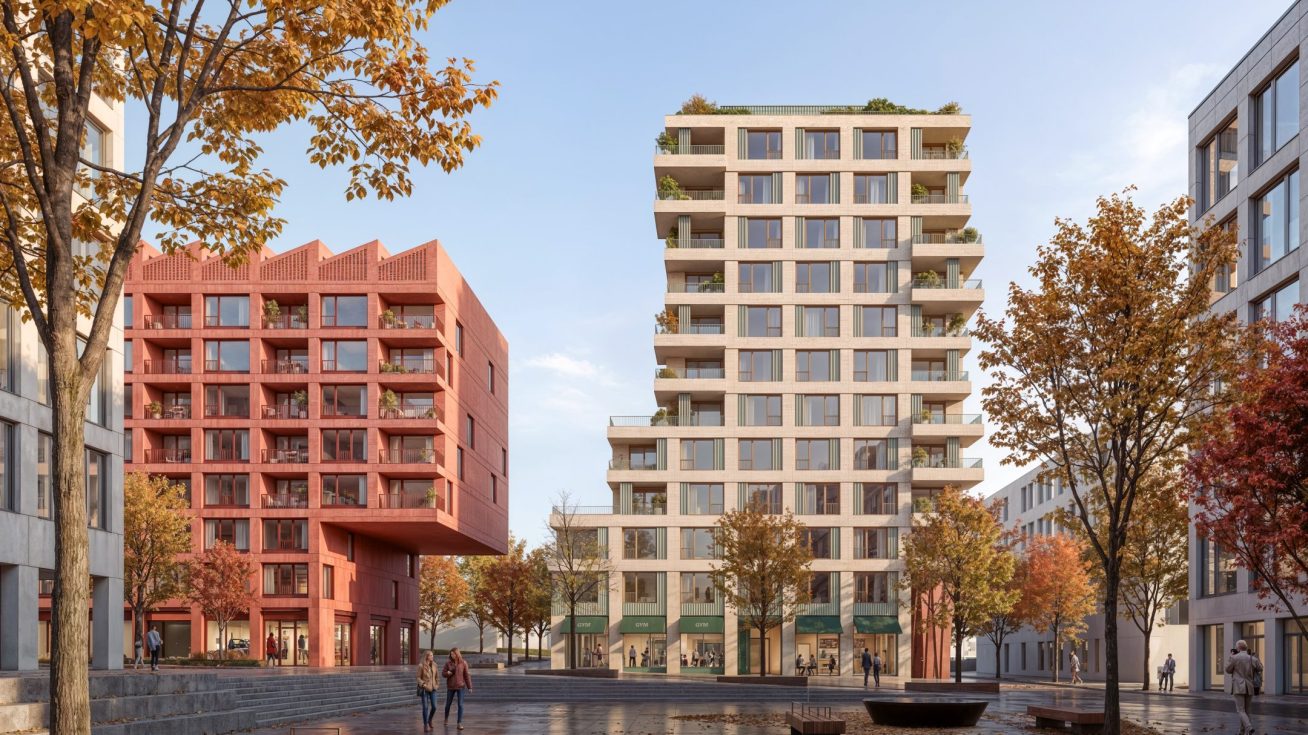
The square near the railway station is also an important entrance area for the new district. The space is dominated by a solitary high-rise building near the railway station, becoming an identifying urban element of the place.
Individual street spaces are designed to create a unique sense of proximity and shared urban home. We minimize traffic intersections and design safe pedestrian zones with optical clarity and intuitive navigation. Sufficient width of the roads allows not only optimal lighting and the incorporation of a cycle path, but also the integration of tree rows and green belts with collection ditches for rainwater infiltration and retention.
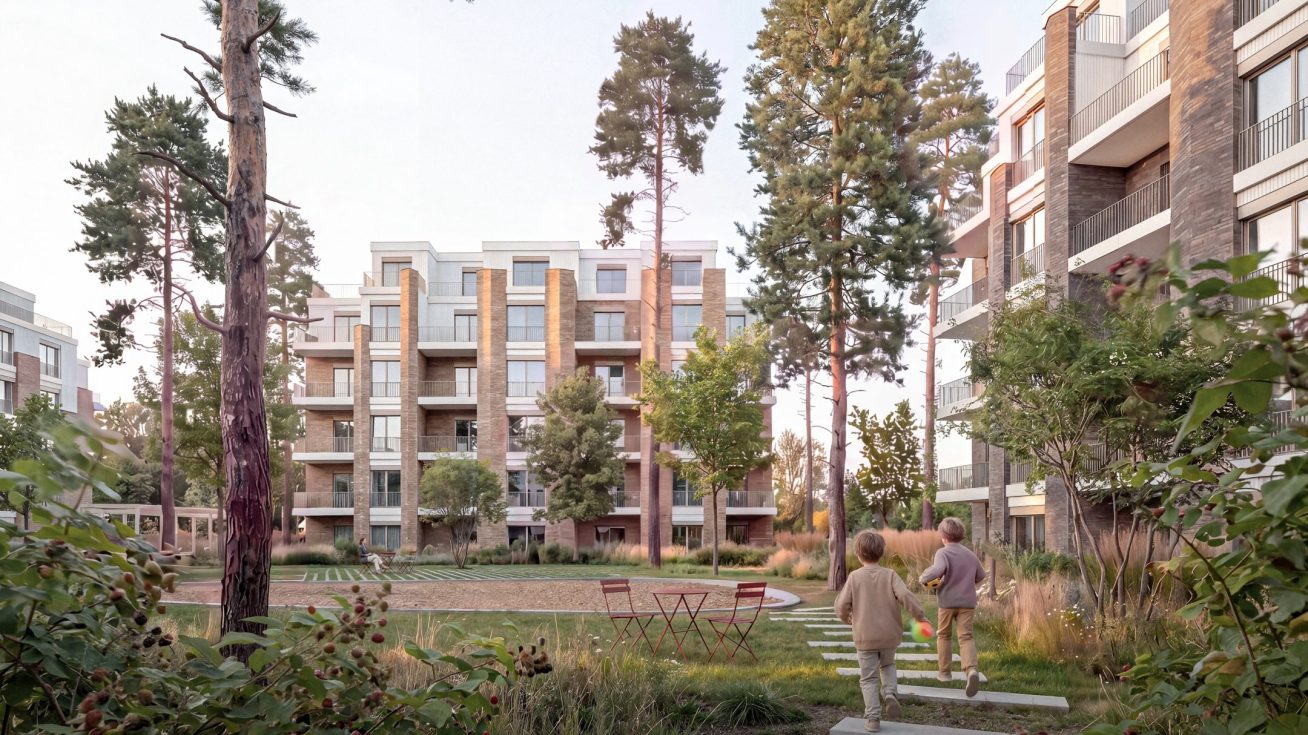
The courtyards of the individual residential blocks include central community zones with play and relaxation areas as well as private front gardens. The entire area of the courtyard gardens is raised to the level of the 1st floor, creating a separate exterior space intended exclusively for residents.