About project
Olomouc is a city with a strong historical identity, but also a place that has been dynamically changing in recent years. Baroque monuments, led by the UNESCO-listed Holy Trinity Column, naturally coexist with contemporary architecture, new public spaces and a vibrant food scene. The city retains its historic character without resigning itself to the needs of the 21st century. century. The proposed project of the multipurpose hall responds to this dual nature of Olomouc, to respect for the historical context and to the need for a contemporary, open and functionally diverse urban environment.
The aim of the unrealised proposal is to create a new urban sub-centre that will link sport, culture, everyday urban life and recreation. The project is conceived as a city for all – a place of meeting, exercise and relaxation that functions both during major sporting and cultural events and in everyday life. The fundamental principle is multifunctionality, flexibility in time and sensitive integration into the urban fabric with an emphasis on the relationship to the Morava River and the proximity to the historic centre.
-
Client
The Statutory City of Olomouc
-
Year
2023
-
Location
Olomouc
-
Co-authors
Baumschlager Eberle
-
Visualisations
Perspektiv
-
-
Architecture
Ján Antal
Martin Křivánek
Anna Karbanová
Silvia Snopková
Matúš Sceranka -
Show all

Functional concept of the complex
The proposed site combines a wide range of functions that are designed to function independently and as an interconnected whole. The proposal includes a multi-purpose hall with a capacity of up to 9,000 spectators for sporting and cultural events, a training ice hall with the possibility of independent operation, a ball sports hall with a capacity of approximately 700 spectators, a wellness and fitness centre with a separate entrance, a hotel with a capacity of approximately 150 rooms, administrative buildings for rent and integrated parking designed with regard to the phasing of construction. The individual facilities are designed to allow independent operation, but also offer the possibility of interconnection during larger sporting or cultural events.
The area in question on Velkomoravská Street, in the immediate vicinity of the Morava River and near the historical centre, has an extraordinary development potential. The former barracks are being transformed into a fully-fledged urban district with good transport connections and a strong relationship to the natural landscape of the river. The project uses this location as a key asset – the city, the park and the river merge into one legible whole.


Structure of the territory and its use
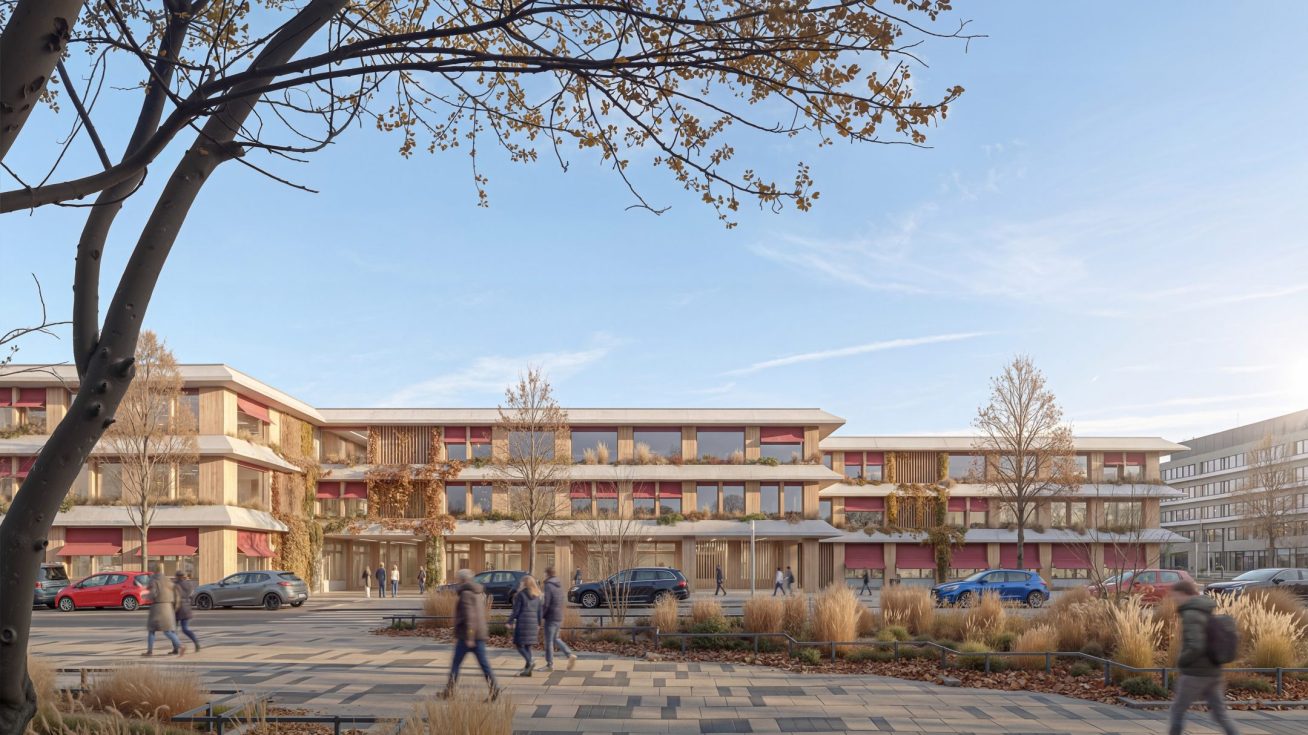
The functional division of the area is based on the urban planning basis and the logic of the phasing of the whole project. The western part of the area is dedicated to a multifunctional hall, which we understand as the main public building of the new district with the potential to bring everyday life to the area. It is followed by the sports city block, which combines a ball sports hall, a training hall and a wellness and fitness centre into one compact volume.
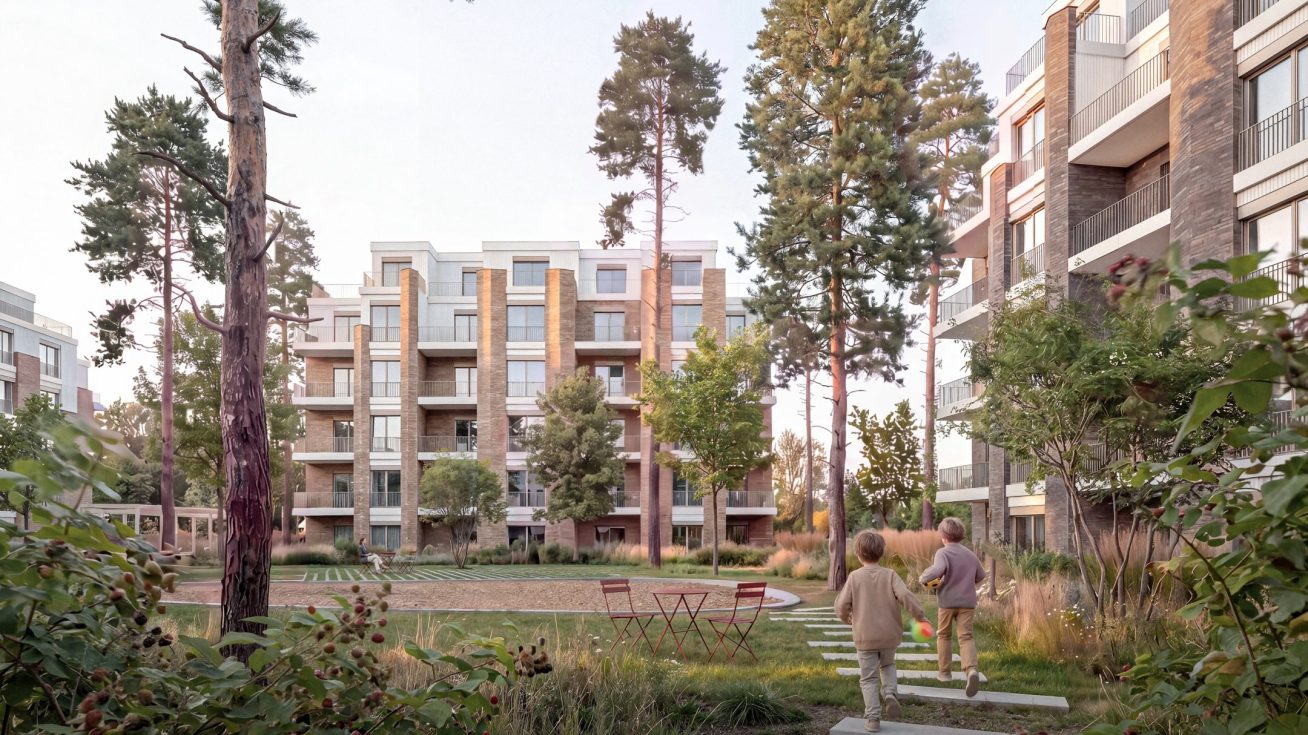
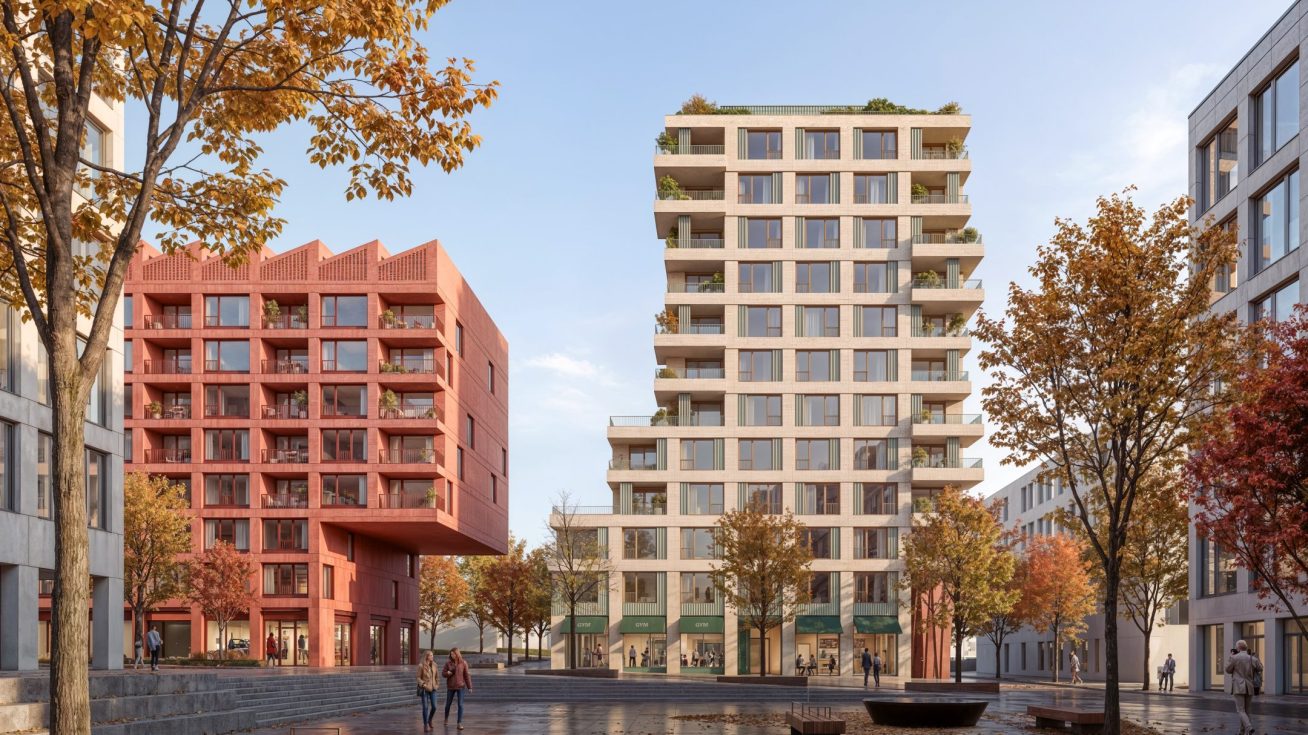
The traditional city block is conceived as a multifunctional unit, with office space along Velkomoravská Street, while the apartment buildings are oriented around a high-quality semi-private courtyard. The dominant position of the hotel encloses the square and at the same time reinforces the urban character and civic amenities of the whole area.


The stadium as a landmark by the river
The form of the stadium is based on the elliptical geometry of the hockey field, which is naturally reflected in the shape of the stands and the overall mass of the building. The stadium is conceived as a solitary object – a sculpture in a park space – whose axis is oriented towards the city skyline and the new Velkomoravské náměstí. This is matched by a clear internal operational layout, designed with an emphasis on intuitive visitor orientation and flexible use of the building. The main entrance is from the level of the adjacent park, while the stadium’s operational facilities are located at the level of the adjacent road. The upper floors are dedicated to skyboxes, a restaurant overlooking the city and playing field, and the Hall of Fame, with the entire operation complemented by clearly separated entrances for the public, players, VIP guests and media.
The architectural form of the stadium is naturally reflected in its structural and façade design. The structural system is based on precast reinforced concrete segments that are regularly arranged around the playing field, allowing for a high degree of prefabrication, speed of construction and economic efficiency. These segments also support the main roof structure and provide a flexible framework for the placement of commercial areas adjacent to the façade. The façade of the stadium works with a motif of perforated sheet metal, which unifies the solid and glazed parts of the building and underlines its overall character. The curved form of the façade ensures its self-supporting character and at the same time refers to the elegance of Baroque ellipses, reinterpreted in a contemporary architectural language.


Urban planning concept
The urban design is based on a legible structure of multifunctional blocks that together form a new urban district. The essential compositional element of the area is the Morava River, which functions as the main landscape axis and a natural link between the historic centre of the town, new buildings and recreational areas in the area. The design emphasises the principle of the city of short distances, the prevention of mono-functional zones and the ability to respond flexibly to changing needs over time. Clearly defined public spaces – parks, squares and courtyards – are an integral part of the concept and support everyday life in the area. A large park area is created in the river bend, complemented by retention measures that are a natural part of the landscape design and enhance its environmental quality.
The specific urban design principles are linked to these starting points. The key decision was to locate the stadium right next to the Morava River, where it becomes not only a sports facility, but above all a public building activating the waterfront and the adjacent park space. The urban structure of the area consists of the stadium as a solitaire in the park, a sports multi-block representing a compact response to the multifunctional assignment, a traditional urban block with a residential inner block and a high-rise landmark in the eastern part of the area. This composition allows for a clear reading of the space, logical links between the different functions and the natural functioning of the new urban district as a coherent whole.